
Periodic cleaning that keeps you at ISO Class 8 .
In a data hall, dust is not a cosmetic issue but an operational risk. Our periodic programme keeps your space within ISO 14644-1 Class 8, between audits and without downtime.
Clean does not stay clean on its own
Contamination builds up without pause. Foot traffic, airflow, equipment changes and outside air all carry particles into the room, and a single clean degrades from the day it is done. For that reason RIFCO treats data centre cleaning as a continuous programme rather than a one-off visit. Periodic cleaning holds the clean baseline in place, at a frequency set to your environment rather than a generic schedule, so soiling never builds back to a level that puts your equipment at risk.
What dust actually costs you
Particles that build up in a data hall are not a blemish. They put uptime, energy use and compliance at risk.
Uptime & reliability
Dust insulates components, blocks fans and makes equipment run hotter, which raises the risk of faults and failure.
Zinc whiskers & shorts
Microscopic metal filaments from zinc-plated surfaces can break loose, travel on the airflow and short out circuits.
Cooling & energy
Contaminated floors, plenums and air paths disrupt airflow, so your cooling works harder and uses more energy.
Compliance & audits
Without maintenance the room drifts below the Class 8 standard, and you cannot demonstrate compliance at an audit.
What a general data centre clean covers
The routine, whole-room work, from the raised floor void to the ceiling and the places dust hides in between.
Raised-floor surfaces
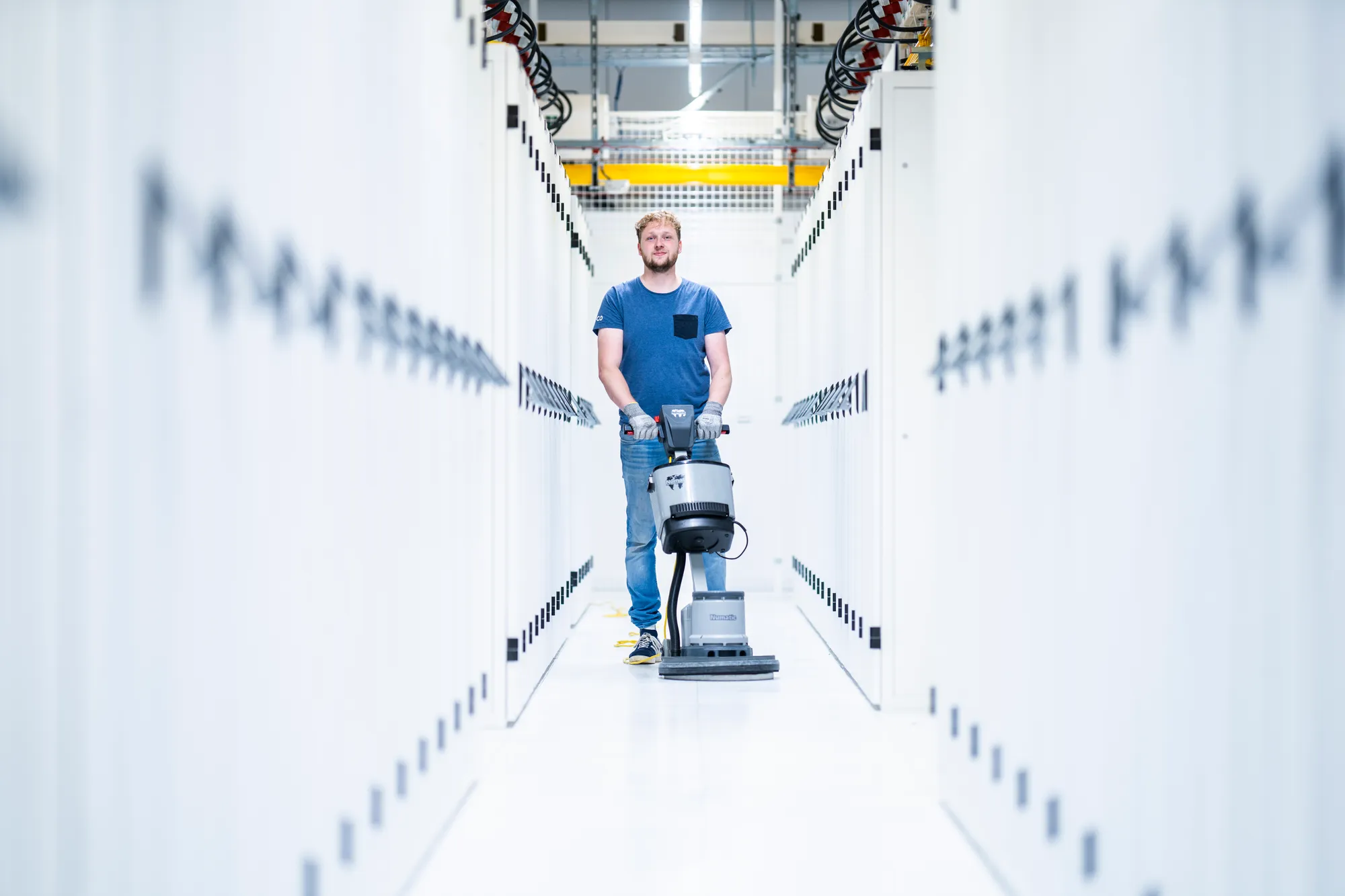
We clean the floor tiles with a high-speed machine that lifts embedded dust and lays down a fresh ESD coating in the same pass. That restores the antistatic protection of the raised floor.
Subfloor plenum & cable trays
The void beneath the floor is a hidden reservoir of dust, debris and cable offcuts that the cold-air plenum blows straight into your racks. We clear it so airflow stays clean.
→ Read more: how we tackle the subfloorRack & cabinet exteriors
Dust on rack surfaces, doors and blanking panels, removed without ever opening live equipment. The inside of patch cabinets is a separate service.
→ Separate service: inside patch cabinet cleaningSurfaces, screens & fixtures
Ledges, glass, doors and the flat surfaces where dust settles. Your own equipment, such as monitors and KVM screens, we leave untouched by default, but can include with your permission.
Ceiling void & overhead infrastructure
Cable trays, containment and overhead trunking up to 2.5 metres, high enough to catch the dust that drops onto your equipment and safe to carry out. We go higher on request, agreed in advance or for special occasions.
CRAC/CRAH air-handling units
These units are sensitive equipment, so the CRAC/CRAH units are not part of the general clean. By default we leave them alone and clean them only as a separate service, agreed in advance.
Entry & circulation zones
Anterooms and walkways, plus the disposable walk-off mats that stop dust being walked into the data hall in the first place.
Anything that does not belong
Cardboard and packaging do not belong in a data hall in the first place, so you will not usually find any. If we do spot something that should not be there, we do not simply remove it. We log it and report it to your site manager or contact.
How we keep it at Class 8
A controlled, repeatable process, matched to your environment and carried out without disrupting your operation.
- 01
Survey & risk map
We map the space, its airflows and its contamination sources, and set the right cleaning frequency.
- 02
Tailored plan
Method, frequency, access and scheduling matched to your operation, so cleaning works around your business.
- 03
Controlled cleaning
HEPA 14 extraction and ESD-safe working, from raised floor and plenum to racks and ceiling void, live and with no downtime.
- 04
Measure & advise
When needed, we measure the airborne particle count against Class 8, and leave you with recommendations for next time.
What is always included
The same controlled standards on every engagement.
HEPA 14 filtration
Dust-free extraction with HEPA 14. Particles leave the room instead of being stirred back into the air.
ESD-safe working
Antistatic materials and ESD-trained staff protect sensitive electronics.
No disruption
We work around your operation, live and with no downtime.
Certified & screened team
VCA VOL, NEN 3140 and ESD-trained, plus security-screened for sensitive sites.
The standard we clean to
Data centre cleaning is judged against a real, measurable standard. This is what RIFCO works to.
ISO 14644-1 Class 8
The international cleanroom air-cleanliness standard. Class 8 allows up to 3,520,000 particles ≥0.5µm per m³, the working benchmark for a data hall.
HEPA 14 filtration
Our extraction captures at least 99.995% of fine particles, so dust leaves the room instead of being stirred back into the air.
ESD-safe working
Antistatic materials and ESD-trained staff prevent the static discharges that damage electronics.
What sets our data centre cleaning apart
Real specialisation, real reach, and a decade in rooms where mistakes are not an option.
-
Critical-environment specialists
Cleaning data centres and critical rooms is what we do, not a sideline of a general cleaning company.
-
One standard, four countries
Genuinely operational in the Netherlands, Belgium, Germany and Spain, with the same controlled method everywhere.
-
A decade in critical environments
70+ data centres and 800+ projects delivered, experience in rooms where downtime is not an option.
-
Starts with a free site survey
Every engagement begins with a free, no-obligation survey of your space and its risks.
Trusted by government, law-enforcement and EU institutions. Our staff are security-screened; we work under strict confidentiality and are insured.
View references →For a specific need
Data centre cleaning is the general programme. For a targeted need, each of these is a dedicated service with its own approach.
Initial deep clean
A one-off intensive clean that brings a room up to standard.
More →Technical room cleaning
For generator rooms, electrical switch rooms and other technical spaces where ESD safety and NEN 3140 are critical.
More →MER/SER room cleaning
Careful work around dense cabling and sensitive connections.
More →Raised floor cleaning
The raised floor and the plenum beneath, countering zinc whiskers.
More →Tile restoration
Worn ESD and computer-room floor tiles restored: 100% of ESD performance recovered and the look up to 90% of original, without replacement.
More →Patch cabinet cleaning
HEPA 14, ESD-safe working and careful handling of connections.
More →HVAC cleaning
Dry and wet-chemical cleaning of rooftop HVAC units and their coils, for efficient and reliable cooling.
More →Particle measurement
ISO 14644-1 classification with certified counters, measurement on request.
More →Frequently asked questions
How often should a data centre be cleaned?
It depends on the environment, typically every 3 to 12 months. We set the frequency from the survey: foot traffic, airflow and contamination sources.
Will cleaning disrupt our operation?
No. We work in live data centres, around your equipment, with no downtime required.
What is the difference between this and a 0-beurt or deep clean?
Data centre cleaning is the ongoing, periodic programme that keeps a room at standard. A 0-beurt (initial deep clean) is the one-off, intensive clean that brings a room up to standard in the first place, often the starting point before periodic cleaning begins.
Do you also clean the HVAC units and inside cabinets?
The general clean covers the in-room cooling-unit exteriors. For dry and wet cleaning of the rooftop HVAC units and their coils, or detailed work inside patch cabinets, we offer those as dedicated services. See HVAC cleaning and Patch cabinet cleaning.
What is ISO 14644-1 Class 8?
An international air-cleanliness standard. Class 8 allows up to 3,520,000 particles ≥0.5µm per m³, the common benchmark for data centres.
Is it safe for live equipment?
Yes. We use HEPA 14 extraction and ESD-safe methods and materials, and all our staff are ESD-trained.
What are zinc whiskers?
Microscopic metal filaments that grow on zinc-plated surfaces, often under raised floors. They can break loose and short out circuits. We remove them and address the source.
Can you measure the result?
When needed, we measure the airborne particle count against Class 8, so the result is verifiable rather than assumed.
Related reading
Background from our knowledge base.
- StandardsISO 14644-1 explainedWhat Class 8 means and why it is the benchmark for data centres.Read more →
- StandardsWhy data centres target ISO Class 8The balance between clean enough and affordable, and why OEMs now require it.Read more →
- StandardsASHRAE TC 9.9: particles and gasesThe guidance behind contamination control, including the often-forgotten gaseous side.Read more →
Ready for a spotless critical space?
A site survey is free and without obligation. We map your space and its risks and propose a tailored plan.
Request a free survey